Schedule a Service
Get fast, reliable plumbing service from our experienced local team. Call us or use the button to book your appointment!

Available 24/7 - We're ready to help!
We respect your privacy.

With Camera Inspection
Many Dallas homeowners discover they have a water intrusion problem during or after a heavy rain event. North Texas receives an average of 37 inches of rainfall annually, and the region’s expansive clay soil does not absorb water quickly. When rain comes fast, water has nowhere to go but toward the lowest point on your property, which is often the crawl space, utility room, or foundation perimeter.
Many Dallas-area homes, particularly those built before 1990 in neighborhoods like Lakewood, Casa View, and Vickery Meadow, have crawl spaces that were never designed with active drainage in mind.
These areas sit on heavily clay-laden soil with limited natural drainage, and water has been finding its way into crawl spaces in the same spots for decades. North Texas storm season runs roughly April through June, with a secondary window in September and October. Homes in these neighborhoods that have not yet dealt with water intrusion are often one heavy spring storm away from their first call.
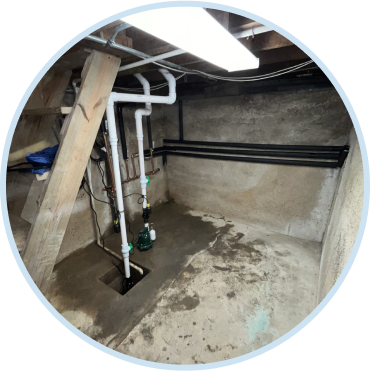
Sump pump installation is not a one-size-fits-all job. The right system depends on your home’s layout, the volume of water you are dealing with, and whether you need primary protection, backup protection, or both. Pure Plumbing handles the full scope from assessment to completed install.
If water is showing up in your crawl space or utility area and the source is not obvious, leak detection can identify whether it is groundwater intrusion, a plumbing leak, or a combination of both. Knowing the source determines whether a sump pump, a pipe repair, or both is the right fix.
Learn more about our leak detection service in Dallas .
A sump pump handles water that has already entered the pit. For homes with recurring surface water problems or slow-draining yard areas, improving the drainage around the foundation works alongside the pump to reduce the total water load reaching the structure.
See our full drainage service options in Dallas .
If your crawl space or utility room has active flooding right now and you need a pump installed or a failed pump replaced immediately, Pure Plumbing is available 24/7 for emergency calls across Dallas.
Learn more about our 24/7 emergency plumbing service.

Most sump pump calls come in one of two situations: right after a flooding event when the damage is visible, or before the wet season from a homeowner who has dealt with water before and does not want to deal with it again. Both are valid. The second one is significantly cheaper.
We hear from Dallas homeowners when:
Some of the calls we get are from homeowners who are listing their home and a buyer’s inspector flagged the crawl space. Others are from homeowners who watched a neighbor deal with flooding last spring and decided not to wait. Both are reasonable. Addressing it before a problem forces your hand is cheaper and faster than dealing with it under pressure.
Water in a crawl space is not just a comfort issue. Dallas clay soil holds moisture against the foundation long after the rain stops, which means the damage window extends well past the storm itself. Persistent moisture accelerates wood rot, supports mold growth, and contributes to foundation movement. In areas like Lakewood and Casa View where older homes sit on graded lots with limited natural drainage, that process can be ongoing from April through the end of storm season. A sump pump removes the water before it has time to do the work the clay was already doing.

Pure Plumbing is based in Richardson and serves the full Dallas metro area. Sump pump installs are a common call across all of our service areas, particularly in older neighborhoods and homes in lower-lying parts of the city.
Sump pump installation done wrong is worse than no pump at all. The two most common failures we see on existing installs are undersized pumps that burn out from constant cycling and discharge lines routed just far enough to get water away from the pit but not far enough to keep it away from the foundation.
We size every pump to the actual water volume your home produces, run the discharge to a clean exit point, and put a check valve on every line. When we leave, the system is set up to work, not just to look installed.
Pure Plumbing has been licensed under #M-43576 and serving the DFW area since 2013. We carry an A+ BBB rating and are available 24/7 for failed pumps and active flooding situations.

©2026 Pure Plumbing. License: #M-43576.
All Rights Reserved Privacy Policy Terms & Conditions
Get fast, reliable plumbing service from our experienced local team. Call us or use the button to book your appointment!
Available 24/7 - We're ready to help!
We respect your privacy.